University of Wisconsin–Madison (UW–Madison) was recertified by the Xerces Society as a Bee Campus in June 2024, extending the university’s status as one of eight colleges in Wisconsin and one of just over 200 in the US to hold the designation.
“This is a moment worth celebrating,” said Ian Aley, Green Fund program manager for the UW–Madison Office of Sustainability (OS) and co-facilitator of the university’s Bee Campus Committee. “We are already seeing the addition of pollinator-supporting habitats and changes of maintenance practices because of this certification, and a lot of relationship-building work and collaboration is happening behind the scenes. Stay tuned: there will be more exciting work in the years ahead!”
A history of collaboration
UW–Madison’s efforts began with its first submission for a STARS rating, the benchmark for tracking sustainability performance at higher education institutions across the world, which recognizes Bee Campus USA certification in its points system.
The Bee Campus Committee that was subsequently established on campus found expertise in many departments. For instance, Susan Carpenter, the native plant garden curator for the Arboretum, began her role in 2003 and noted a rise in interest for pollinator gardens on campus in 2010, when a visitor from the University of California–Davis spotted a rusty patched bumble bee in the garden. In 2013, the Arboretum served as a case study for a bumble bee conversation document published by the Xerces Society.
Hannah Stahmann and Emily Valentine, co-chairs of the student sustainability advocacy group Campus Leaders for Energy Action Now (CLEAN) and members of the ASM Sustainability committee, contributed to Bee Campus recertification through their campaign to reduce the use of pesticides and increase native plants via Re:wild UW–Madison, another student group that they oversee. While faculty and staff Bee Campus efforts continued, the students decided to reach out to the Green Fund with proposals for rewilding their campus.
“Madison already has such a beautiful campus, but we want to make it beautiful for everyone. Cut lawns and synthetic pesticides aren’t good for the soil, or the ecosystem,” Valentine said.
To learn how to effectively campaign for action at UW–Madison, Stahmann said they attended trainings by Re:wild Your Campus, the broader nationwide student organization. Yet at the meeting, she realized they did not need the preparation after all.
“It was really a pleasant surprise,” Stahmann said. “We found out that there were already people on campus that were really interested in doing this, and that were doing it in a different way. That was really amazing to hear and made me hopeful.”
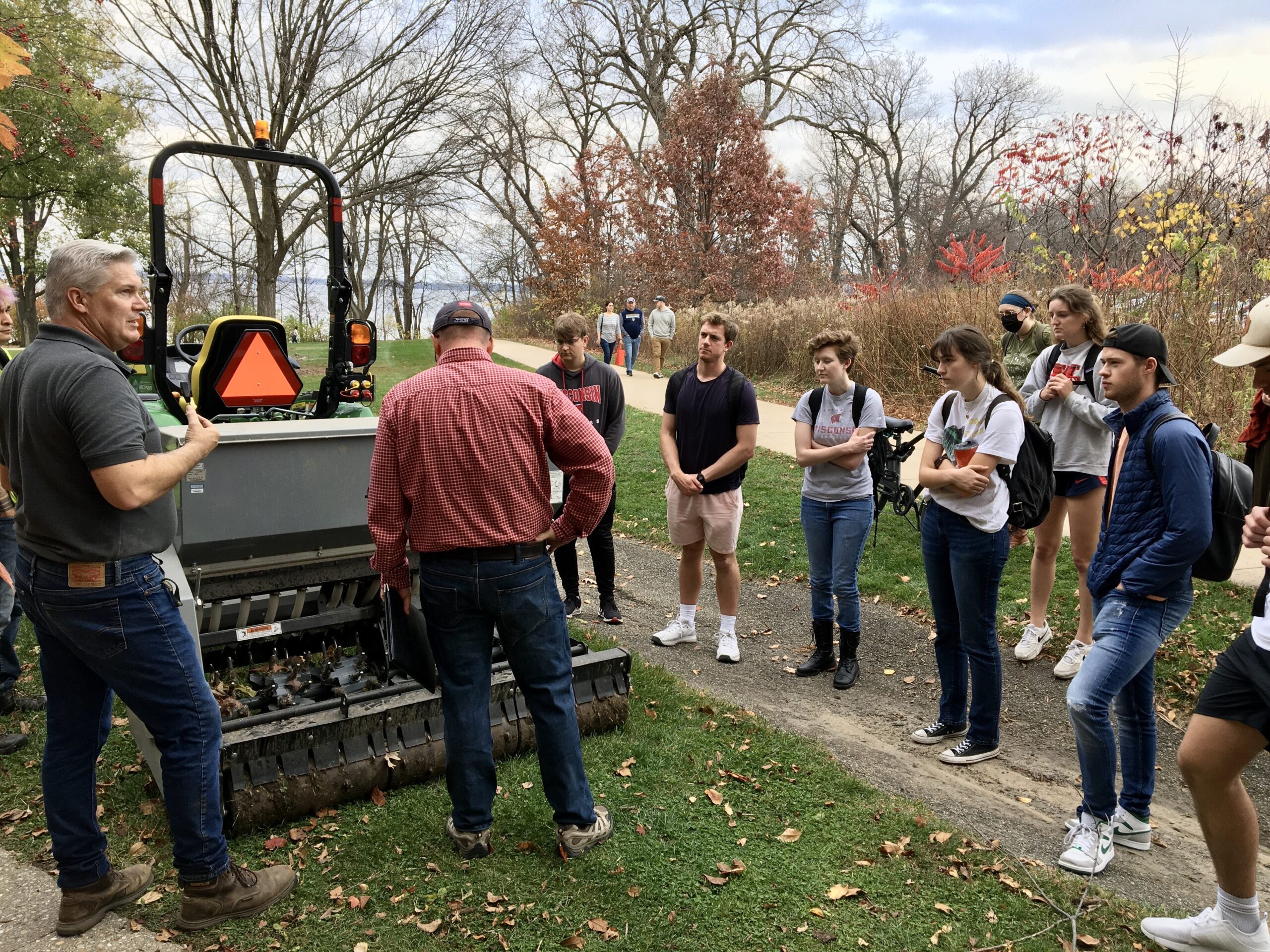
Stahmann and Valentine’s successful proposal means that the Green Fund will pay to help establish an organic landscape management pilot on four campus sites: Library Mall, Henry Mall, Ogg Residence Hall, and the Divine Nine Plaza, where the university’s Grounds section staff will forego synthetic inputs, opting for soil testing, site-specific efforts to support soil health like the application of compost, and mechanical techniques to manage pests. Faculty in the Department of Plant Pathology will offer services and share expertise in sustainable turfgrass management with Grounds staff, while the Bee Campus Committee will advise the team during the pilot.
“This is definitely showing students that the university cares about their health, about the future of the planet, and about the health of Grounds workers,” Stahmann said.
The Bee Campus recertification also informed students and staff about actions already happening on campus, such as Grounds staff’s shift to an integrated pest management system for greenhouses, as well as the substitution of insecticidal soap spray for glyphosate (Roundup) to treat weeds at the Arboretum. A group of Green Fund students and partners established a pollinator lawn at Tripp Residence Hall. Another team is establishing a native plant garden at the School of Education, featuring plants that benefit pollinators and hold cultural significance to native peoples of Wisconsin, so that the garden can be a resource for place-based indigenous education on campus. The Green Fund is also supporting a team of students and partners with the creation of a bee hotel at Allen Centennial Garden.
The future of (bee) campus
UW–Madison turned 175 over the past academic year; this year, the Arboretum turns 90. The anniversaries have spurred action, like the university’s new sustainability goals.
Claudio Gratton, a professor in the Department of Entomology whose lab studies pollinators and the benefits of insect conservation, looked to the recertification as a marker of societal and institutional progress, and as a beacon for the future.
“When I started here 20 years ago, we weren’t really talking that much about climate change and the impact that it has on people’s daily lives,” he explained. “What I’m seeing now is there’s a collective sense of, if we can work together on some of these challenges, we can mitigate the worst outcomes that might occur if we let things kind of continue the way that they are.”
With the data collection that led to the recertification, the staff plans on continuing to establish effective land care practices and scaling them up across campus.
“This is not a one-year project, this is not a ten-year project,” Gratton continued. “This is a mindset-change project that is going to continue on for a long time, and that’s what I’m particularly excited about.”
This post was adapted from an article by Marek Makowski.
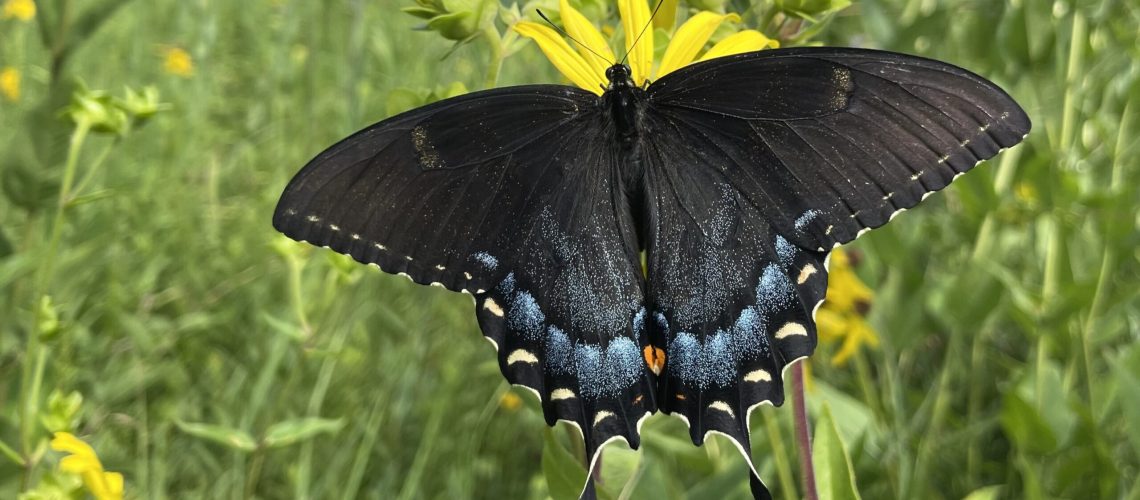
Photo at top: A tiger swallowtail (black morph female) was spotted during the Insect Ambassador Butterfly event at the Biocore Prairie in the Lakeshore Nature Preserve. Credit: Adam Gundlach.