

A large group of people pose close together on a sunny day with the ocean in the background.

Introducing Our New Integrated Pest Management (IPM) Plan Toolkit

We know quality guidance on outdoor integrated pest management (IPM) plans can be tough to find. And if you do find resources, they are often too regionally-specific or overlook crucial elements.

Here at Bee City and Bee Campus USA (BCUSA), we are lucky to have the support of nearly 100 Xerces Society staff members, with one very special subset: our wonderful Pesticide Reduction team. These talented scientists shape policy, design user-friendly handouts, conduct serious research, and still find time to support our BCUSA community.

Over the past year, I’ve had the privilege of working with Aaron Anderson, Pesticide Program Specialist, as we created our latest online resource: an IPM Plan Toolkit! This resource is free to the public, so please share with anyone and everyone.

In honor of this launch, we’ve asked Aaron to share a bit about his motivation for designing the toolkit, and what it provides.

I’m so excited for you all to check it out.

– Laura Rost, National Coordinator, Bee City USA and Bee Campus USA

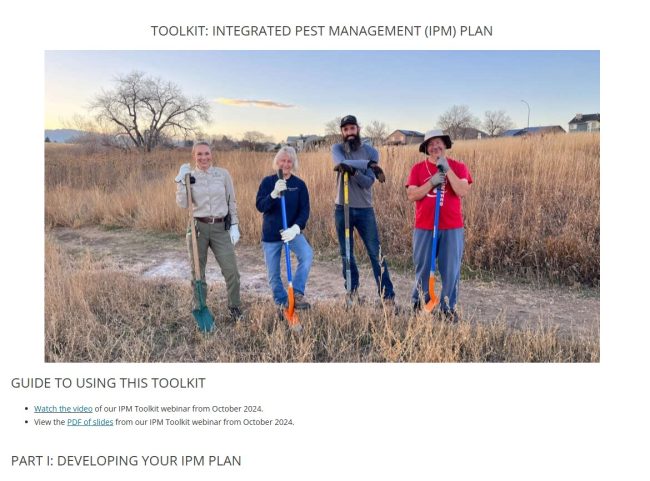
A screenshot of the first page of the toolkit.
Introducing Our New Toolkit

By Aaron Anderson

Bee City USA and Bee Campus USA (BCUSA) affiliates do amazing work to protect pollinators. Every time I read the renewal reports, I’m impressed by the steps affiliates are taking, from planting flowers to community outreach. One of the core BCUSA commitments is to create and enhance pollinator habitat, and in 2023 alone, affiliates improved over 1,878 acres of habitat! This is an impactful increase to habitat quantity and connectivity in communities and campuses across the country. Beyond adding pollinator plants and nesting resources, the next step is protecting this habitat from pesticides. On the Xerces Society’s Pesticide Reduction team, we often tell people that we don’t want to go through all the work of creating habitat and attracting pollinators to it, only to have those pollinators put at risk by pesticide applications. 

Fortunately, by joining BCUSA affiliates have committed to taking that step and reducing the use of pesticides. Many have implemented policies like creating no-spray zones in pollinator habitat, only using pesticides as a last resort, or eliminating pesticide use entirely. We ask affiliates to formalize their commitment to pesticide reduction by creating and adopting an integrated pest management (IPM) plan, and to continue to work to find ways to further protect pollinators. However, this can sometimes feel like a daunting task, especially if an affiliate does not have an existing plan. 

Image of a document
Our new IPM Checklist is also available as a printable PDF.

To support affiliates in their pesticide-reduction efforts, we recently created new resources on ecologically-based IPM plans. Whether a community or campus is just starting this process or is working to fine tune an existing plan, these materials contain information to help guide the process:

  1. We define and explain IPM concepts and key elements of plans. 
  2. Our new IPM checklist provides a list of elements and practices that an ideal plan would contain. 
  3. Finally, we have a page with case studies and example IPM plans from cities and campuses of various sizes and case studies of affiliates doing excellent pesticide reduction work.
 

Creating and improving IPM plans can be a process, and we don’t expect all affiliates to incorporate all of these elements immediately! But, we hope that these new materials can serve as guidance and provide insight as you go through this journey. Please reach out to us with any questions or feedback you may have. 

Header Image: Each Saturday in Seaside, CA, volunteers meet to enhance and create new pollinator habitats at parks. Credit: Bee City USA – Seaside, CA.

Author

A smiling person in front of a orange and brown muralAaron Anderson
Pesticide Program Specialist
Towns and Cities Lead
The Xerces Society

Aaron Anderson works with the public and Xerces staff to reduce pesticide use in residential landscapes, including promoting alternative pest control measures and pollinator-friendly gardening practices. Prior to joining Xerces in 2022, he researched pollinator conservation in urban landscapes, restored habitat for several endangered butterfly species, and worked in insect biocontrol. In 2021 he was an AAAS Mass Media Fellow at the St. Louis Post-Dispatch, where he reported science and business stories. Aaron has a PhD from Oregon State University, and outside of work you can probably find him riding his bike, science writing, or fiddling with old cameras.

Share this post

advanced-floating-content-close-btn

Help us empower communities to protect the life that sustains us! DONATE