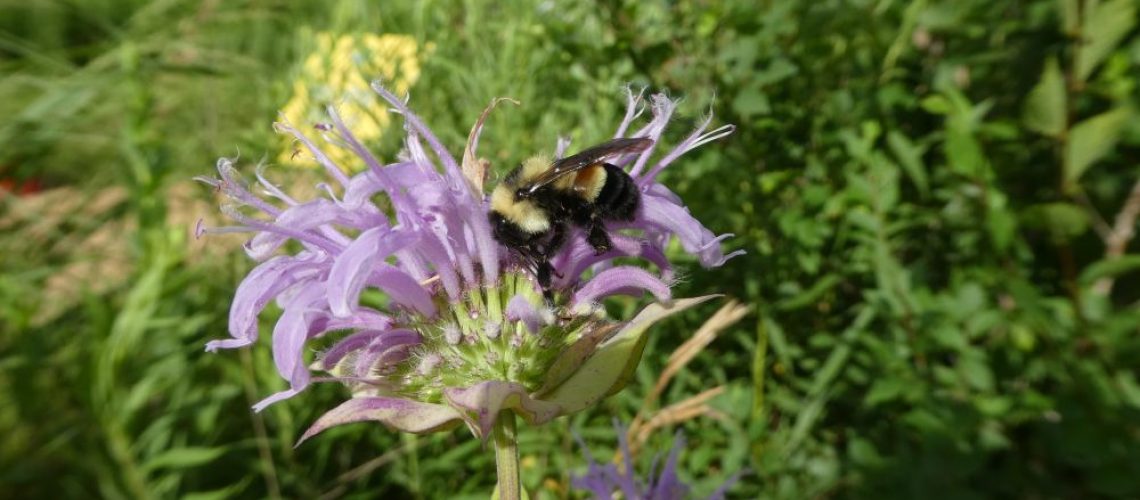
The Xerces Society for Invertebrate Conservation welcomes the U.S. Fish and Wildlife Service’s historic decision to designate more than 1.5 million acres of critical habitat for the endangered rusty patched bumble bee (Bombus affinis). This important milestone helps safeguard the places this bee needs to find food, raise young, and survive the winter across select counties in six states: Illinois, Iowa, Minnesota, Virginia, West Virginia and Wisconsin.
The designation also represents a major step forward for pollinator conservation, following the Xerces Society’s petition to list this species in 2013. It reflects years of dedication from researchers, conservation partners, volunteers, and community scientists working to better understand and protect this iconic native bee.
While critical habitat designation does not protect these habitats from all threats, it importantly prohibits the federal government from taking any action that destroys or adversely modifies designated areas.
The designation marks a significant advancement in the recovery of the rusty patched bumble bee. Since the species was listed as endangered in 2017, conservationists, scientists, and advocates have worked to ensure that habitat protection remains a priority. This final rule recognizes the essential role that healthy habitat plays in the survival and recovery of the species and provides an important foundation for future conservation efforts.
The Xerces Society remains committed to working alongside federal and state agencies, universities, private landowners, and other partners to conserve the rusty patched bumble bee and its habitat. We also celebrate the thousands of volunteers who contribute to our Bumble Bee Atlas program and other community science efforts. Their observations and dedication have expanded our understanding of bumble bees and helped make conservation successes like this possible. Together, we will continue working toward a future where the rusty patched bumble bee and the diverse ecosystems it supports can recover and thrive.
Authors

Rich manages all aspects of the Xerces Society’s work on bumble bees. Rich has a master’s degree in conservation biology from San Francisco State University, and he joined the Xerces Society in 2012. While earning his degree, his thesis focused on local- and landscape-level factors that contribute to bumble bee species richness and abundance. He has also investigated native bee pollination in agricultural systems in the Central Valley of California and researched endangered butterflies in the San Juan Mountains of Colorado, as well as throughout the Pacific Northwest.